
Table of Contents
You got three quotes for your move from Montreal to Toronto. All three companies said they could do it. All three quoted you completely different prices. One said LTL. One said container. One said freight. They all sound like they mean the same thing but they do not, and the price difference between them could be thousands of dollars.
This article breaks down what each one actually means, which one is cheapest for your specific move, and why most moving companies will not explain this to you clearly. We are AKA Moving, a Montreal-based moving company, and we use all three methods depending on what the customer needs. Here is what you need to know.
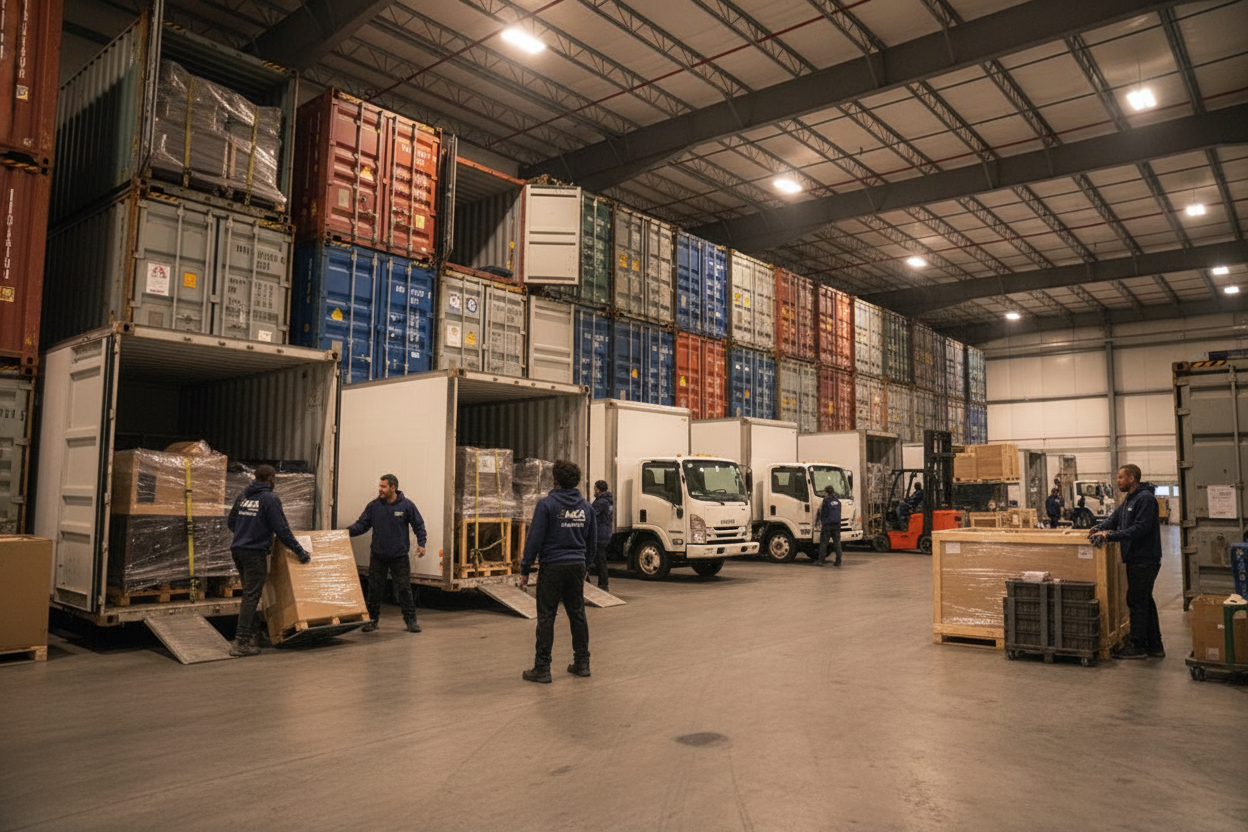
What Are LTL, Container, and Freight Shipping?
Before we compare them, let us define them. Most moving company websites throw these terms around without explaining what they actually mean. Here is the plain version.
Freight Shipping
Freight shipping is the umbrella term. It refers to transporting large or heavy goods over long distances using trucks, trains, ships, or planes. Everything below is a type of freight shipping. When someone says “we use freight” without specifying, they are telling you nothing useful.
LTL (Less Than Truckload) Shipping
LTL is a shipping method where your belongings share space in a truck with other customers’ belongings. You only pay for the portion of the truck your stuff takes up. This is the cheapest option for most residential moves because you are not paying for a whole truck you do not need.
Container Shipping
Container shipping uses large standardized metal containers, typically 20 feet or 40 feet long. You can either rent the whole container (FCL, Full Container Load) or share it with other customers (LCL, Less than Container Load). Container shipping is common for overseas moves and long cross-country hauls where the container travels by rail or ship for part of the trip.
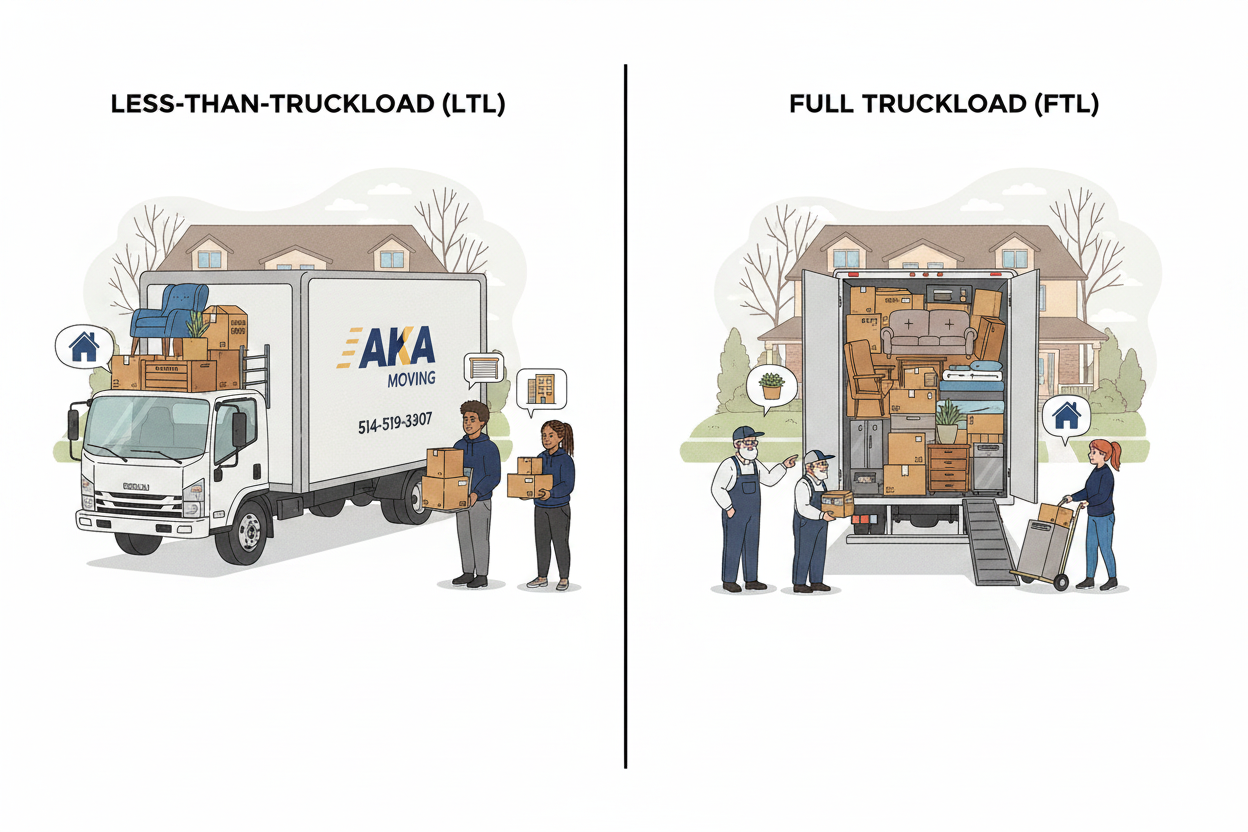
When to Choose LTL Shipping
LTL is the budget option. If you are moving a small apartment, a partial household, or just a few pieces of furniture, LTL is usually the cheapest and most practical choice.
Ideal Scenarios for LTL
- A studio, 3.5, or 4.5 apartment move from Montreal to another Canadian city
- You are moving a partial household (you already have furniture at the destination)
- Your shipment is between 150 and 15,000 pounds
- You have some flexibility on the delivery window
- You want to keep costs down without sacrificing professional handling
Why LTL Saves You Money
The math is simple. A full moving truck from Montreal to Toronto costs the same whether you fill it or leave half of it empty. If you only have 40 percent of a truck’s worth of stuff, you are paying for 60 percent of empty air. LTL means that empty air gets filled with someone else’s stuff, and both of you split the cost.
What LTL Is Not Good For
LTL is not the right fit if your move is time-critical, if you have a full house worth of belongings, or if you have fragile items that cannot handle being shifted between stops. Since the truck picks up and drops off from multiple customers along the route, transit times are longer than a dedicated full truck move.
When to Choose Container Shipping
Container shipping is the right choice when you have a lot of stuff, when you are going overseas, or when you want the security of your belongings being sealed in one container from start to finish.
FCL (Full Container Load)
FCL means you rent the entire container for your exclusive use. We load it in Montreal, seal it, and it stays sealed until it reaches your destination. FCL makes sense for large houses, international moves, or cross-country hauls where your goods travel by rail for part of the journey.
LCL (Less than Container Load)
LCL is the container version of LTL. Your belongings share a container with other customers. This is cost-effective for smaller international shipments but adds handling at the origin and destination because the container has to be unpacked and sorted.
Container Is Built for Overseas and International
For domestic Canadian moves like Montreal to Toronto or Montreal to Ottawa, containers are usually overkill. A standard moving truck or LTL shipment gets it done faster and cheaper. Where containers shine is overseas moves, Montreal to Europe, Montreal to the Middle East, or long-haul cross-country moves where the container travels by rail for part of the trip.
When to Choose Freight Shipping
When people say “freight shipping” in the context of residential moves, they usually mean this: your household goods travel with a freight carrier rather than a dedicated moving company truck. This is the method we use at AKA Moving for many of our long-distance moves, and it is the reason we are cheaper than the big van lines.
Why Freight Shipping Is Cheaper for Residential Moves
Traditional van lines charge by weight and distance plus a premium for full-service moving. Freight carriers charge by space used. If your furniture is crated properly and palletized, it takes up less space than if it was just loaded loose into a truck. We build custom crates, palletize the load, and ship via freight. The result: we can quote you 20 to 40 percent less than a traditional van line and still deliver door-to-door with setup.
The custom crating secret: Our crew measures every piece of furniture, cuts plywood to fit, and builds a wooden crate around it in our warehouse before it ever touches the truck. Your items travel protected inside wood, not just blankets. This is how we can ship via freight without damage. See our long-distance moving services for details.
Freight Classes Explained in Plain English
Freight carriers categorize shipments by “class,” which is based on density, handling, and liability. Denser, easier-to-handle items are cheaper to ship. Fragile, bulky, or oddly shaped items are more expensive. The freight class system runs from 50 (cheapest) to 500 (most expensive). Most household goods fall in the middle range.
You do not need to calculate your own freight class. A good moving company handles this for you. The reason we mention it is so you understand why “get the total weight” is not the whole story when pricing a long-distance move.
The Side-by-Side Comparison
Here is the comparison chart we wish every moving company would hand you upfront.
| Method | Best For | Typical Price | Speed | Security |
|---|---|---|---|---|
| LTL | Small apartments, partial households, 150-15,000 lbs | Lowest for small moves | Slower (multiple stops) | Moderate (items handled multiple times) |
| FTL (Full Truckload) |
Full houses, time-sensitive moves | Higher, but fixed | Fastest (direct route) | High (one truck, one crew) |
| LCL (Less than Container Load) |
Small overseas shipments | Moderate for international | Slow (consolidation required) | Moderate |
| FCL (Full Container Load) |
Full overseas or long-haul moves | Higher, but sealed one-way | Moderate | Highest (sealed until destination) |
| Freight + Custom Crating (AKA’s method) |
Cross-Canada residential moves where you want van-line quality at freight prices | 20-40% cheaper than van lines | Moderate to fast | High (crated, not just wrapped) |
What Nobody Tells You About Freight Shipping
Here is the part moving companies do not advertise. Freight shipping has some drawbacks you need to know about if you are going to use it for a residential move.
Delivery Windows Are Not Exact
When you book a freight shipment, you get a delivery window, not a specific day and time. A 3-day window means it could arrive on day 1, day 2, or day 3. If you are flying out to meet the truck at your new home, this matters.
Most Freight Carriers Drop at a Terminal, Not Your Door
A true freight carrier drops your shipment at their terminal, and you have to arrange the last-mile delivery yourself. This is where most “cheap long-distance movers” get their low quote. They ship your stuff freight, dump it at a terminal in Toronto, and you are left figuring out how to get it to your actual new address. AKA Moving does not do this. We run the full route door-to-door.
Standard Moving Insurance Does Not Apply
Freight shipments are typically covered at the freight standard rate of $0.60 per pound, which is not real insurance. At AKA Moving, we include proper coverage on every long-distance move and can help you arrange additional coverage for high-value items.
Read more on this: Our guide to cheap long distance moving goes deeper into the $0.60 per pound insurance scam and what real coverage looks like.
How AKA Moving Does It Differently
We combine the best of all three methods. Here is our approach in plain terms.
Step 1: We Custom Crate Everything
In our warehouse at 10500 Cote-de-Liesse in Lachine, our crew measures every piece of furniture, builds wooden crates around the bigger items, and wraps the smaller ones in protective blankets and shrink wrap. This lets us ship via freight or LTL without the usual damage risk.
Step 2: We Consolidate Routes
We run regular routes to Toronto, Ottawa, Quebec City, and cross-border to the US. When we have multiple customers on the same route, we consolidate. Your stuff shares our truck with other customers’ stuff, which is how we pass the savings on to you.
Step 3: We Deliver Door-to-Door
Unlike a typical freight carrier, we do not drop at a terminal. Our own crew delivers to your new address, unloads, reassembles your furniture, and removes the packing materials. You tell us which room, we put it there.
Step 4: We Run Our Own Trucks, Own Crews
No brokers. No third-party hand-offs. No changing trucks at the border. Your belongings stay in our custody from pickup to delivery. GPS tracking is live the whole time.
The Math: Why AKA Is Cheaper Than the Big Van Lines
A traditional North American van line quotes you based on weight and distance, then adds full-service premiums on top. We ship via LTL or freight with custom crating, consolidate routes when possible, and deliver door-to-door with setup. Same result for you, 20 to 40 percent less cost.
Frequently Asked Questions
What do FTL, LTL, FCL, and LCL mean?
FTL (Full Truckload) and FCL (Full Container Load) mean you have exclusive use of an entire truck or container. LTL (Less Than Truckload) and LCL (Less than Container Load) mean you share the space with other shippers. LTL/LCL is cheaper for smaller moves. FTL/FCL is faster and more secure for larger moves.
Are there size or weight limits for LTL and container shipping?
LTL is generally for shipments between 150 and 15,000 pounds. Standard shipping containers come in 20-foot and 40-foot lengths. A 20-foot container can hold roughly 48,000 to 52,000 pounds. A 40-foot container can hold up to 58,000 pounds. Most residential moves fit easily within LTL limits.
Is LTL more cost-effective than full container shipping for moving?
For smaller moves (studios, 3.5 apartments, partial households), LTL is almost always cheaper because you only pay for the space you use. A full container is usually only cost-effective for large family homes or overseas moves. Call AKA Moving and we will tell you which one fits your specific move.
Does AKA Moving use freight or traditional moving trucks?
Both, depending on what is best for your move. For full-house moves within driving distance (Toronto, Ottawa, Quebec City), we typically use our own moving trucks. For cross-country moves (Vancouver, Calgary) and cross-border (Boston, NYC), we use custom crating plus freight or LTL. Either way, we deliver door-to-door with our own crew at the destination.
Get a real quote, not an estimate range. Call AKA Moving at (514) 915-3967 and we will walk you through which shipping method fits your specific move and give you a real price, not a guess. Or visit our long-distance moving page for more on our routes, custom crating, and compliance.