
How to Spot Long Distance Moving Scams and Hidden Costs in Canada
You got three quotes for your long distance move. Two were around the same price. One was half that. You are reading this because something about that low quote felt wrong. Good instinct. The moving industry in Canada has real scam operators, and the low quote is usually the first sign.
By Matthew Dacar · Updated November 19, 2026
A long distance moving scam usually costs you in one of three ways: a final bill 30 to 50 percent above the quote, your belongings held on a truck until you pay more, or a $3 payout for a $2,500 laptop.
To protect yourself, get a written estimate after an in-home or video survey, check the mover’s CTQ carrier number, pay only a small deposit by credit card, and never treat $0.60 per pound as real insurance.
We are AKA Moving, a Montreal mover with a real address and a real track record. This is an honest look at how the bad operators in our industry work, what it costs you when you get caught, and how to protect yourself. The fine print is where the scam lives. Most customers never read it. A reputable mover explains it upfront.

Know the playbookWhat are the most common long distance moving scams in Canada?
These scams follow the same playbook every time. Once you know them, you can spot them in the first five minutes of a phone call.
Hostage holdings (the big one)
Rogue movers load all your belongings onto their truck, then refuse to deliver until you pay much more than the quote. They claim “unexpected charges” that were never on the bill of lading. You face an impossible choice: pay the inflated bill or risk never seeing your belongings again.
Lowball estimates, then bait and switch
If a quote seems too good to be true, it is. The dishonest mover gives you an attractive low price to lock you in, then inflates the final bill with “unexpected” charges they knew about from day one.
Fly-by-night companies and brokers
Some moving companies appear out of nowhere and change their name often to escape bad reviews. Minimal online presence, no branded trucks, no physical office, just a website and a phone number.
How the other two scams end in a hostage load
Scams 2 and 3 are usually not separate scams. They are the first half of scam 1. The low price or the missing company gets your belongings onto the truck. The hostage holding is how they get paid.
- You book the cheapest quote.
- The truck is loaded, and the “real” weight or extra charges appear.
- The new bill is 30 to 50 percent higher, or more.
- Pay it, or your belongings do not come off the truck.
- You book a company with no address, or a broker.
- Your move is sold to a carrier you have never heard of.
- That carrier demands more money at delivery. The company you booked stops answering.
- Pay it, or your belongings do not come off the truck.
Why calling the police usually does not help
Many people expect the police to get their belongings back. In most cases they will not. You handed your belongings over yourself, under a contract, so police usually treat a billing dispute with a mover as a civil matter between you and the company, not theft. They may take a report, but they will rarely order the truck unloaded.
That leaves the courts. In Quebec, small claims court handles claims up to $15,000, and it takes months. A fly-by-night company is hard to sue: it may have changed its name, have no real address, or be registered in another province. Even if you win, collecting the money from a company that has disappeared is another fight.
The only reliable protection is before the truck is loaded: a written estimate with the total price, a mover with a real address you have checked, and a deposit paid by credit card.
AKA Moving is not a broker. On Direct Truck we run our own truck with our own crew, out of our own warehouse in Dorval. On Express Shipping our crew builds your pallets in that same warehouse, and they travel with the freight carriers we work with year round. Either way you book with us, you call us, and we answer for your belongings from pickup to delivery.
Red flagsWhat are the warning signs of a bad moving company?
If you see even one of these, slow down. Two or more, walk away.
No physical address
A real moving company has trucks, equipment and an office. If the only address is a post office box or a home, walk away.
Hesitant to share credentials
In Quebec, commercial carriers are registered with the CTQ (Commission des transports du Québec). Ask for the carrier number. A reputable company answers in 10 seconds. A scam operator stalls.
Large upfront deposit
A small deposit is standard. A big share of the total upfront, especially in cash or by wire transfer, is a major red flag. Those payments are untraceable if the company disappears.
No in-home or video survey
An accurate estimate requires seeing what you are moving. A quote given sight-unseen over the phone is a guess. Expect it to change on moving day.
Pressure to sign now
“This price is only good today.” “Sign now to lock in the truck.” These are pressure tactics. A reputable mover gives you time to read the contract.
| What to check | Scam operator | Reputable mover |
|---|---|---|
| Address | PO box or a home address | Office and warehouse you can visit |
| Quote | Over the phone, sight-unseen | In-home or video survey, written estimate |
| Deposit | Large, cash or wire transfer | Small, by a traceable method |
| Credentials | Stalls when asked | CTQ number in 10 seconds |
| Coverage | $0.60 per pound sold as insurance | Explains coverage before the move |
Ask before you signWhat hidden fees do long distance movers charge?
Here is the full list of fees that may or may not be in your quote. Ask about every one before you sign, and get the answers in writing.
1At pickup
- Stairs and elevators: per-flight or per-floor charges. A 3-storey walk-up can add hundreds of dollars.
- Long carry: if the truck cannot park close to your door, a charge per metre of carrying.
- Shuttle fees: if your street is too narrow for a large truck, a smaller truck and a transfer fee.
- Packing supplies: boxes, tape, bubble wrap. Most cheap quotes leave them out.
- Packing labour: an hourly charge on top of the move if they pack for you.
- Overloaded boxes: a fee when packed boxes exceed weight limits.
- Heavy or bulky items: pianos, safes, pool tables, hot tubs, large appliances. Each can add hundreds.
2During transport
- Fuel surcharge: a percentage of the bill based on current fuel prices.
- Route tolls: toll roads and bridges, which add up on cross-border moves.
- Border crossing fees: customs brokers, paperwork and waiting time at the border.
3At delivery
- Long carry at destination: the same charge, now at your new address.
- Furniture reassembly: often billed separately from the move.
- Appliance installation: hooking up washers, dryers and stoves.
- Storage in transit: daily storage fees if delivery is delayed.
4If things go wrong
- Access charges: some storage facilities charge to let you reach your own belongings.
- Redelivery fee: charged if nobody is home to accept delivery.
- Claim filing fees: some companies charge you to file a damage claim. Yes, really.
At AKA Moving, we do not have these hidden costs. Our quote includes the move: stairs, long carry, basic packing materials and reassembly at destination. Everything is disclosed upfront. See our long distance services or get a long distance quote.
The fine printIs $0.60 per pound moving insurance enough?
No. This is the trap that catches the most people, and understanding it changes how you read every long distance quote.
Most long distance movers include “basic liability coverage” in their quote. It is not real insurance. It is a common industry rate that pays $0.60 per pound of damaged goods, no matter what the item is worth.
| Item | Weight | Replacement cost | Basic payout |
|---|---|---|---|
| 55-inch flat screen TV | 75 lbs | $800 to $2,000 | $45 |
| Apple MacBook Pro | 5 lbs | $2,500 | $3 |
| Leather sofa | 200 lbs | $1,500 to $3,000 | $120 |
| Grandmother’s china cabinet | 250 lbs | Irreplaceable | $150 |
If a mover destroys your $2,500 MacBook and offers $3, they are not breaking the rules. They are following basic liability to the letter. That is the trap. The rules themselves favour the mover.
Worse: the deductible
Some movers add a deductible on top of the $0.60 per pound. $350 is typical. A deductible is the amount you absorb before the mover pays anything. Every damaged item first gets used up against it.
Five pieces worth $7,400 destroyed, and the cheque is $115. The first four items paid nothing at all: they only shrank the deductible. The mover starts paying on the fifth item, once the deductible hits $0.
Pays by weight, not value. Often with a deductible.
You declare the shipment’s value. Damaged items are repaired or replaced at current market value.
More than triple the standard, no deductible on any service. More coverage available as an extra.

At AKA Moving, there is no deductible on any service. Every long distance move is covered at $2.00 per pound, and during transport we can include up to $15,000 of damage insurance on your shipment, at no extra cost on Express Shipping and USA Shipping. We walk you through what is covered and what is not before the move, not after something breaks.
Same move, real coverageHow much does AKA Moving pay if something breaks?
AKA Moving pays $2.00 per pound with no deductible, from the first dollar, on every long distance move. On the same Montreal to Toronto move with 5 damaged pieces, that is $1,550 instead of $115: more than 13 times what basic liability with a $350 deductible pays. And during transport, we can include up to $15,000 of damage insurance on your shipment.
$115
$1,550
Up to $15,000 of damage insurance during transport
The $2.00 per pound is our base coverage, with no deductible. On top of that, during transport we can include up to $15,000 of damage insurance on your shipment. Express Shipping and USA Shipping include it at no extra cost.
On the example move, $7,400 of belongings were damaged. That is well inside the $15,000 limit, instead of the $115 cheque from basic liability.
Straight talk: $2.00 per pound alone is not full replacement value, which is why the transport insurance matters. Tell us what you are moving and we confirm how the coverage applies to your shipment, in writing, before anything goes on the truck. If you need more than $15,000, ask us. Extra coverage is available.
5-minute checkHow do I know if a moving company is legitimate in Canada?
Run these five checks. If a company cannot pass all of them, do not put your belongings on their truck.
- Check their CTQ number. In Quebec, commercial carriers are registered with the Commission des transports du Québec. Every legitimate carrier has a number.
- Check Canadian Association of Movers (CAM) membership. CAM members commit to a code of conduct. Non-members are not automatically scams.
- Check their Better Business Bureau (BBB) record. Look at the rating and complaint history. The pattern matters more than one complaint.
- Search the company name plus “scam” or “complaints”. Real complaints show up fast. So do fake ones, so look at patterns.
- Drive by their address. The ultimate test. A real mover has a warehouse, trucks and an office. A fly-by-night operation has a mailbox.

Where to report a moving scam in Canada
The opposite of a scamHow is AKA Moving different?
This guide is not just about what to avoid. It is about what to look for. Here is how AKA Moving is set up to give you the opposite of what scam operators offer.
A real address you can visit
Our office is at 10500 Côte-de-Liesse, Suite 124, Lachine. Our warehouse is at 1977 Boulevard Hymus, Dorval. Come by any weekday. We are not hiding behind a post office box.
BBB accredited, with a real record
We have served Montreal for years with Better Business Bureau accreditation. Our complaint history is public. Go check it.
CTQ compliant, near-perfect safety rating
Registered with the Commission des transports du Québec. Our trucks are ELD compliant, paperwork is current, and we pass weigh stations without incident.
A survey before every quote
In-home or video. We see what you are moving, give you a real price, and it does not change unless you add items on moving day.
No deductible, on any service
A claim is paid from the first dollar at $2.00 per pound, more than triple the $0.60 standard.
No hidden fees, no pressure
Stairs, long carry, basic packing materials and reassembly at destination, disclosed upfront. Take your time with the contract.
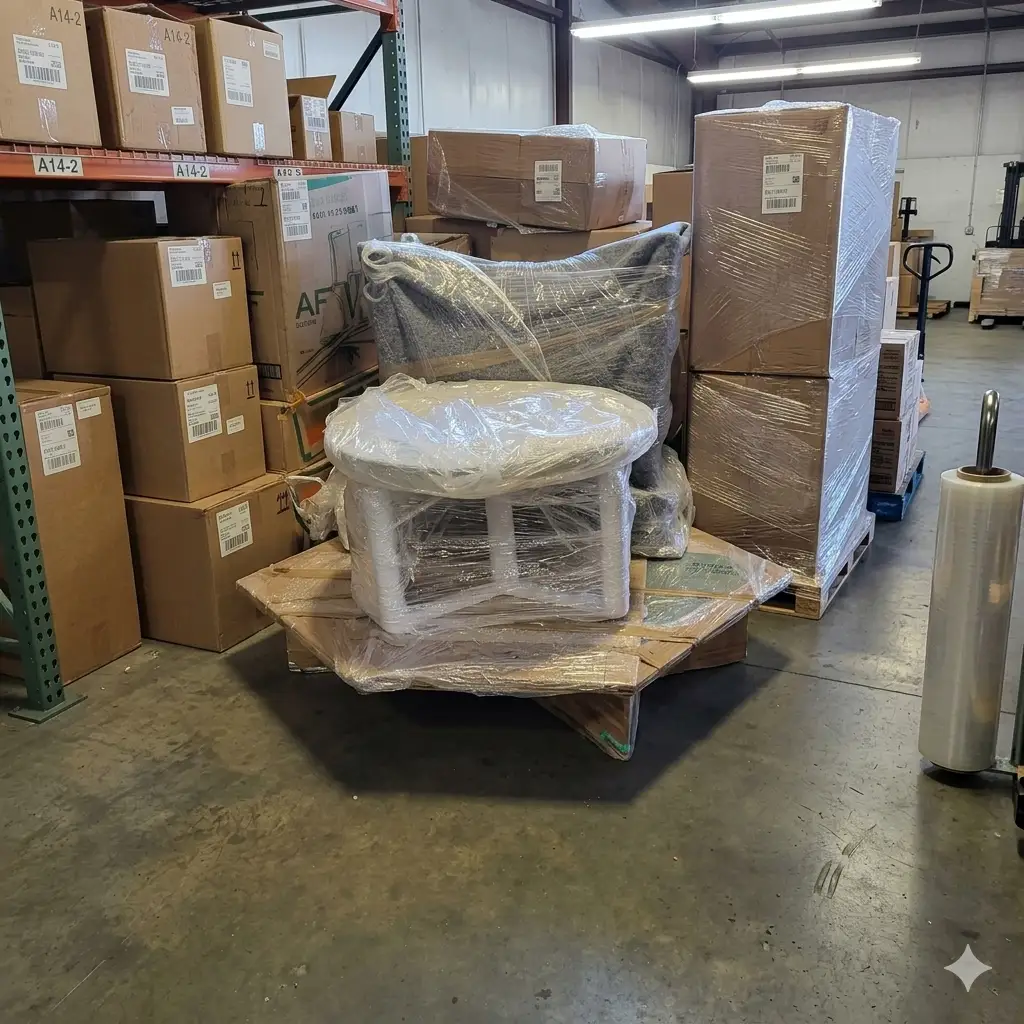
One company accountable, from warehouse to living room. No brokers. Our own crew wraps, loads and palletizes everything. On Direct Truck moving, our own truck drives it to your door. On Express Shipping, your pallets ride with freight carriers we vet and work with year round. You deal with us the whole way. GPS tracking is available on request.
Quick answers
How do I know if a long distance moving company is legitimate in Canada?
Ask for its CTQ carrier number (in Quebec), check its BBB record and Canadian Association of Movers membership, search its name with “scam” or “complaints”, and visit its address. A legitimate mover has a warehouse, trucks and an office, and gives a written estimate after seeing what you are moving.
What is a moving hostage scam?
It is when a mover loads your belongings, then refuses to deliver until you pay far more than the quote, blaming charges that were never on the bill of lading. It usually starts with a lowball quote or a fly-by-night company. Police often treat it as a civil matter, not theft, so checking the mover before loading is your real protection.
Is $0.60 per pound moving insurance enough?
No. Basic liability at $0.60 per pound pays by weight, not value, so a 5 lb laptop worth $2,500 pays $3. Ask for full value protection, or choose a mover with stronger coverage. AKA Moving covers every long distance move at $2.00 per pound with no deductible.
How much does AKA Moving pay if my belongings are damaged?
AKA Moving covers every long distance move at $2.00 per pound with no deductible, so a claim is paid from the first dollar. On a move with 775 lbs of damaged belongings, that is $1,550, compared with $115 under $0.60 per pound basic liability with a $350 deductible. During transport, AKA Moving can include up to $15,000 of damage insurance on your shipment, included at no extra cost on Express Shipping and USA Shipping, and extra coverage is available beyond that.
How much deposit is normal for a long distance move?
A small deposit is standard. Be wary of any mover asking for a large share of the total upfront, especially in cash or by wire transfer. Paying by credit card lets you dispute the charge if the company disappears.
What is the difference between a moving broker and a moving company?
A moving company has its own trucks and crew and does the move. A broker sells your move to another carrier, often the lowest bidder, and is not responsible for the service. Ask directly whether it is their own truck and their own crew.
Why is one moving quote so much lower than the others?
A quote far below the others is usually a lowball estimate. The weight is underestimated, or stairs, long carry, shuttle and fuel charges are left out, and the final bill comes in 30 to 50 percent higher. Ask for every possible extra charge in writing.
What hidden fees should Canadians watch out for?
Stair and elevator charges, long carry fees, shuttle fees for narrow streets, fuel surcharges, border crossing fees on US moves, storage in transit and reassembly at destination. Get a detailed written list of every possible extra before signing.
What should I do if my mover is holding my belongings hostage?
Stay calm and get everything in writing: the original estimate, the new bill and every message. Do not pay cash. File a police report for the record, though police often treat it as a civil matter. Then file complaints with your provincial consumer protection office and the Canadian Anti-Fraud Centre, dispute any credit card payment, and get legal advice. In Quebec, small claims court handles claims up to $15,000.
Can I sue a moving company that held my belongings?
Yes, but it is slow and often does not get your money back. In Quebec, small claims court handles claims up to $15,000 and takes months. A fly-by-night company may have changed its name, have no real address or be registered in another province, so even a win can be hard to collect. Checking the mover before booking is far cheaper.
Where can I report a moving scam in Canada?
Report it to your provincial consumer protection agency (the Office de la protection du consommateur in Quebec), the Canadian Anti-Fraud Centre, the Canadian Association of Movers and the Better Business Bureau. If you paid by credit card, also dispute the charge with your card company.
What makes AKA Moving different from the movers in this article?
AKA Moving has an office at 10500 Côte-de-Liesse in Lachine and its own warehouse in Dorval, is BBB accredited, CTQ compliant with a near-perfect safety rating and ELD equipped, and runs its own trucks and crew. We survey before quoting, disclose all fees upfront and cover moves at $2.00 per pound with no deductible.
- Long distance moving from Montreal
- Get a long distance moving quote
- Direct Truck: our truck, our crew
- Express Shipping by pallet
- ELD compliance: why to ask your mover
- Moving from Montreal to Toronto
- Moving from Montreal to Ottawa
- Moving from Montreal to Vancouver
- Relocating a company to Montreal
- Moving cost calculator
Get a quote with nothing hidden in it
Call AKA Moving and we will walk you through every line item, answer every verification question in 30 seconds, and put the price in writing.
Sources: Commission des transports du Québec, Office de la protection du consommateur, Canadian Anti-Fraud Centre, Canadian Association of Movers, Better Business Bureau. Coverage and pricing details are AKA Moving’s own. Last checked: November 2026.