
Table of Contents
You got the job in Boston. Your TN visa is approved. Now you need to figure out how to move your apartment from the Plateau to Cambridge.
Most moving companies in Montreal will quote you a price, pick up your stuff, drive it to the border, and then hand it off to a US carrier for the final delivery. Your belongings change trucks, change crews, and change accountability. When something gets broken or lost, nobody is responsible. This is how cross-border moving usually works. This is not how AKA Moving does it.
This article is about getting your stuff across the border safely, with one truck, one crew, one company responsible from Montreal to your new address in the United States.
What This Article Covers (and Does Not)
Let us be clear upfront. AKA Moving is a moving company. We are not immigration lawyers. We are not tax advisors. We are not financial planners.
This Article Covers
How to physically move your household goods from Montreal to the United States. Customs paperwork for your belongings. What you can and cannot bring. Who should handle the move. What it costs. What AKA Moving offers for cross-border relocations.
This Article Does Not Cover
Visa applications (TN, H-1B, Green Card). Tax residency planning. Canadian vs US health insurance. US banking and credit. Real estate advice. For all of that, talk to an immigration lawyer and a cross-border financial advisor. Both are worth the money.
Once your visa is approved and you have a destination address in the US, we handle the move. Here is what you need to know.
Why Most Cross-Border Movers Are Actually Brokers
If you search Google for “moving from Montreal to USA,” most of the companies you find are not actually moving companies. They are brokers. Here is how their model works.
- The broker takes your quote request. They give you a price.
- The broker hires a Canadian carrier to pick up your stuff in Montreal.
- At the border, your belongings are transferred to a US carrier because the Canadian carrier does not have US operating authority.
- The US carrier delivers to your address. Maybe. If all goes well.
- If something goes wrong, the broker points at the carriers, the carriers point at the broker, and you are stuck with a lost or damaged shipment and no one taking responsibility.
The Hand-Off Is Where Everything Goes Wrong
Every time your belongings are transferred from one truck to another, the risk of loss, damage, or theft increases. Items get rushed. Inventory sheets get missed. A box labeled “kitchen” ends up on the wrong truck and gets delivered to someone else’s house in a different state.
AKA Moving Runs the Full Route
We have the operating authority to drive our own trucks across the Canada-US border. One truck, one crew, one bill of lading from your door in Montreal to your door in the United States. No broker. No hand-off. No “we can’t find box 47.”
What That Looks Like Operationally
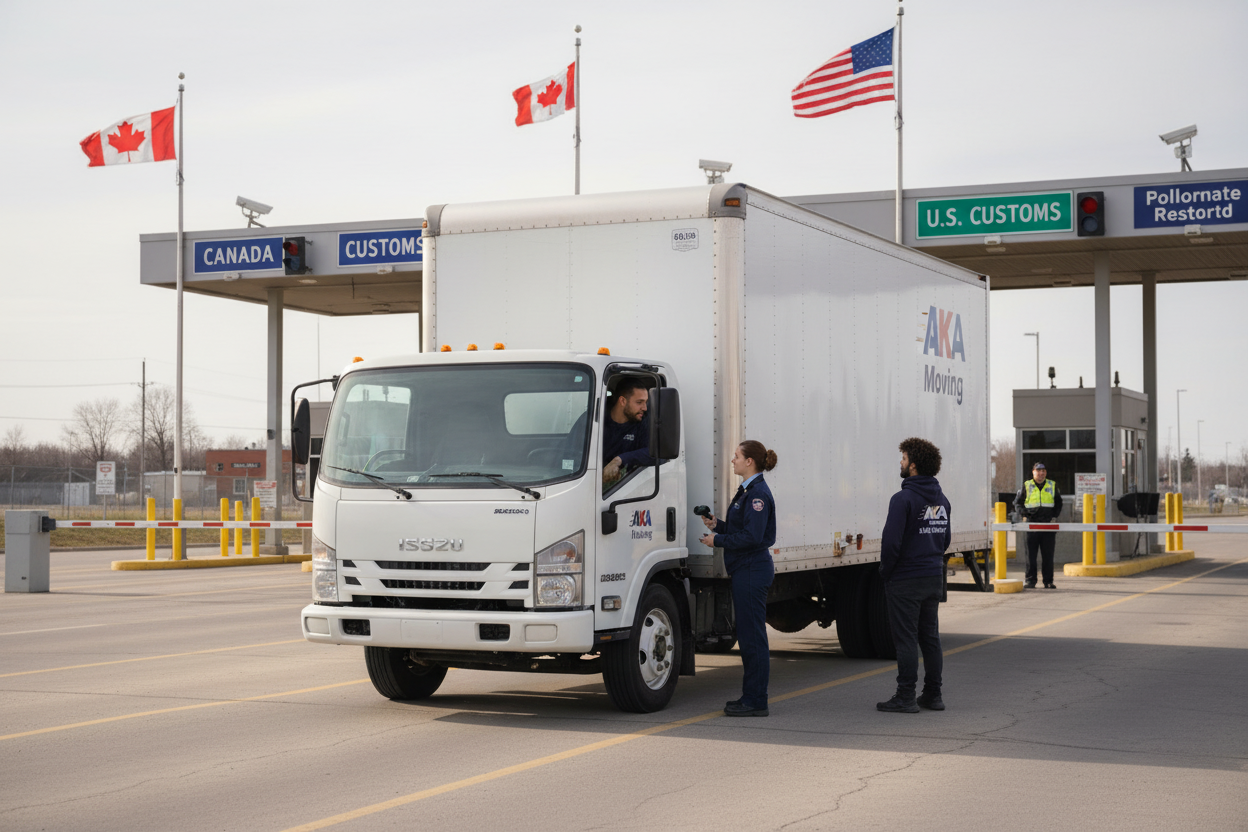
Our truck loads at your apartment in Montreal. We drive to the border. We clear customs with your paperwork. We continue on to your US destination. Our crew unloads. Our crew reassembles your furniture. Our crew removes the packing materials. Same company, start to finish.
How a Cross-Border Move Is Different from a Domestic Move
A move from Montreal to Toronto is a provincial border crossing. A move from Montreal to Boston is an international border crossing. Here is what changes.
Customs Paperwork for Your Belongings
Every item in your shipment must be declared to US Customs and Border Protection (CBP). This is done through a form called US Customs Form 3299, which declares the items as “unaccompanied articles” (personal household goods entering the country separate from you).
Your Belongings Get Inspected at the Border
CBP officers can and do inspect cross-border moving trucks. They may open boxes to verify the contents match the inventory. If something is not declared or is misdeclared, the truck can be delayed, fined, or in extreme cases, your belongings can be seized. Honesty is the policy.
Timing Is More Complicated
For domestic moves, your truck leaves Montreal and arrives at the new address a few days later. For cross-border moves, there are extra steps: customs clearance paperwork, potential inspection delays at the border, and the requirement (in many cases) that you be present in the US before your shipment arrives. This means you typically fly or drive to your US destination ahead of the truck.
Dual Compliance Required
Cross-border moving trucks must comply with BOTH Canadian and US regulations. Canadian ELD rules on the Canadian side. Federal Motor Carrier Safety Administration (FMCSA) rules on the US side. A Canadian-only carrier cannot legally operate long-haul in the US. If your mover does not have US operating authority, they are handing your stuff off at the border (see above).
Read our ELD compliance article for a deeper look at what happens when a mover is not properly compliant. It matters even more for cross-border moves.
Customs Documents You Need for a Cross-Border Move
Here is the document checklist for a typical Montreal to US move.
| Document | Purpose | Who Provides It |
|---|---|---|
| US Customs Form 3299 | Declaration of unaccompanied articles (your household goods) | Your moving company helps you complete it |
| Detailed Inventory List | Numbered list of every box and item being shipped | Your moving company creates it during packing |
| Bill of Lading | Transportation contract between you and the mover | Your moving company issues it |
| Passport | Proof of identity at the border | You bring your own |
| Visa or I-94 Arrival Record | Proof of legal right to enter the US | You provide |
| Proof of US Address | Lease, purchase documents, or utility bill at destination | You provide |
| CBP Form 7501 (if applicable) | Entry summary for items that may be subject to duty | Customs broker or mover with authority |
The One-Year Ownership Rule
Most of your used household goods qualify for duty-free entry under the “Free Entry of Unaccompanied Articles” provision of US Customs. The condition is that you have owned and used these items for at least one year before the move. Items you bought recently may be subject to duty.
What You Cannot Bring Across the Border
This list saves people from border delays and fines. Read it before you pack.
Prohibited (Do Not Pack These)
- Firearms and ammunition without the required ATF permits and paperwork
- Illegal drugs including some prescriptions that are legal in Canada but controlled in the US
- Fresh fruits, vegetables, and meats (USDA restrictions)
- Soil and live plants (agricultural restrictions)
- Ivory, turtle shell, and products from endangered species
- Counterfeit goods of any kind
Restricted (Declare and Expect Questions)
- Alcohol – small amounts allowed, larger quantities subject to duty
- Tobacco products – limited quantities
- Prescription medications – bring only what you need, in original labeled containers
- Used appliances – may require cleaning and pest inspection
- Cultural artifacts and antiques – may need documentation of origin
- Large amounts of cash ($10,000+ must be declared)
Pack Documents with You, Not on the Truck
Keep all important documents (passports, visas, birth certificates, medical records, immigration paperwork, tax documents) in your personal luggage. Do not pack them on the moving truck. If the truck is delayed at the border or en route, you still need these documents to live and work in your new country.
AKA Moving’s Cross-Border Service
Here is what a cross-border move with AKA Moving actually looks like.
We Have Dual Operating Authority
AKA Moving is authorized to operate commercial vehicles in both Canada and the United States. Our trucks are ELD compliant in both countries. Our paperwork is current on both sides of the border. This is what allows us to run the full route without hand-offs.
We Handle the Customs Paperwork
We complete Form 3299 with you. We create a detailed inventory during packing. We prepare the bill of lading. We coordinate with US Customs at the border. You focus on your visa, your job start date, and your new life. We focus on your stuff.
We Cross the Border with Your Shipment
The same truck that leaves your apartment in Montreal arrives at your new home in the US. Our crew crosses with it. No third-party driver. No unknown company taking over. Same faces, same truck, same accountability.
We Deliver, Unload, and Reassemble
When the truck arrives at your new US address, we do not drop off boxes and leave. We unload, we reassemble your furniture, we install your washer and dryer where code allows, and we remove the packing materials. You tell us which room, we put it there.
What This Means for You
One contract. One crew. One company responsible from day one to delivery day. If something gets damaged, you call us. If something is missing, you call us. No phone tag between a broker and a US carrier and a Canadian dispatcher. Just us.
Popular Cross-Border Routes from Montreal
These are the routes we run most often. Each one has its own considerations based on distance, border crossing, and US customs office.
500 km, typically crossed via Champlain-Lacolle. 1-2 days with customs.
600 km, crossed via Champlain-Lacolle. 2-3 days with customs and NYC traffic.
160 km, easy same-day run via Highgate Springs crossing.
100 km, the closest US city. Same-day service possible.
700 km. 2-3 days with customs clearance and route planning.
500 km. 1-2 days, typically via the Champlain crossing.
900 km. 3-4 days including customs.
Long-haul moves using custom crating and freight consolidation. Contact us for quote.
What Is Included in a Cross-Border Quote
- Full packing and wrapping of all items
- Custom crating for valuables and oversized items
- Loading at your Montreal address
- US Customs Form 3299 preparation
- Inventory list creation
- Border clearance coordination
- Transport to your US destination
- Unloading and placement in rooms
- Furniture reassembly
- Removal of all packing materials
- Proper insurance coverage (not $0.60/lb basic liability)
Frequently Asked Questions
How much does it cost to move from Montreal to the United States?
Cost depends on the destination, the size of your household, and the shipping method. Short runs like Montreal to Plattsburgh or Burlington VT are similar in price to a domestic long-distance move. Longer runs like Montreal to Florida or Texas cost more because of distance. Cross-border moves typically cost 15-30% more than equivalent domestic moves due to customs paperwork and border time. Call AKA Moving at (514) 915-3967 for a specific quote.
How long does it take to get my belongings across the border?
For short runs (Plattsburgh, Burlington, Boston) typically 1-3 days. For medium runs (NYC, Philadelphia, DC) 2-4 days. For long-haul moves (Florida, Texas, California) 5-10 days. Times include customs clearance at the border, which can add a few hours to a day depending on the crossing and current wait times.
What paperwork do I need at the border for my household goods?
You need your passport, your US visa or I-94 arrival record, a detailed inventory of your shipment, US Customs Form 3299 (declaration of unaccompanied articles), a bill of lading from your mover, and proof of your US address. Your moving company should help you prepare all of these except your personal identity documents.
Does AKA Moving drive the truck across the border, or do you hand it off to a US carrier?
We drive our own truck across the border with your shipment. We have dual operating authority in Canada and the United States, and our ELD devices are certified for use in both countries. Same truck, same crew, same accountability from your door in Montreal to your door in the US. No hand-offs, no brokers, no changes in carrier.
Getting ready for a cross-border move? Call AKA Moving at (514) 915-3967 and we will walk you through the whole process. From customs paperwork to door-to-door delivery, we handle the move so you can focus on your new life. Visit our long-distance moving services page for more on our routes and compliance.