Moving in Montreal · November to April
Moving in Winter in Montreal
Snow Operations, Parking and the Cold
The crew can work at minus 20; what stops a winter move is a street closed by a snow-loading operation, and this page shows how to plan around it.
| Month | High / low | Snow | Days under -20 |
|---|---|---|---|
| November | 6 / -2 °C | 19 cm | 0 |
| December | -1 / -9 °C | 49 cm | 2 |
| January | -5 / -14 °C | 50 cm | 8 |
| February | -3 / -12 °C | 41 cm | 4 |
| March | 3 / -7 °C | 36 cm | 1 |
| April | 12 / 1 °C | 13 cm | 0 |
The thing that actually stops a move
How Montreal snow removal works, and when it closes your street
Montreal plows from 2.5 cm of snow and starts a citywide loading operation once 10 to 15 cm has piled on the curb, about five times a winter. During loading, temporary orange signs close one side of your street for a window of hours, posted the same day before 3 p.m. for a 7 p.m. to 7 a.m. ban and the evening before, by 8 p.m., for a daytime ban. A car left there is towed, $99 plus storage, and about 50,000 are every year. A loading operation takes four days and four nights to cover the city.
The City clears 10,000 km of streets and sidewalks with 2,500 vehicles and nearly 3,000 people. Salting and plowing happen within hours and rarely affect a move. Loading, when the trucks and blowers come to carry the snowbanks away, is the operation that closes streets, and it is announced per sector, not citywide, which is why the sign on your block matters more than the forecast.

Plowing: from 2.5 cm
Streets and sidewalks are cleared as soon as 2.5 cm is on the ground, salting at the same time up to 5 cm. Priority streets are salted within four hours. This does not close anything; it narrows the street and buries the curb.

Loading: from 10 to 15 cm
When the snowbank on the curb reaches 10 to 15 cm, the borough launches a loading operation. Targets: four days for 10 to 20 cm, five days or more past 30 cm. Each sector is announced the morning of, and the trucks start at 7 p.m. that day or 7 a.m. the next.
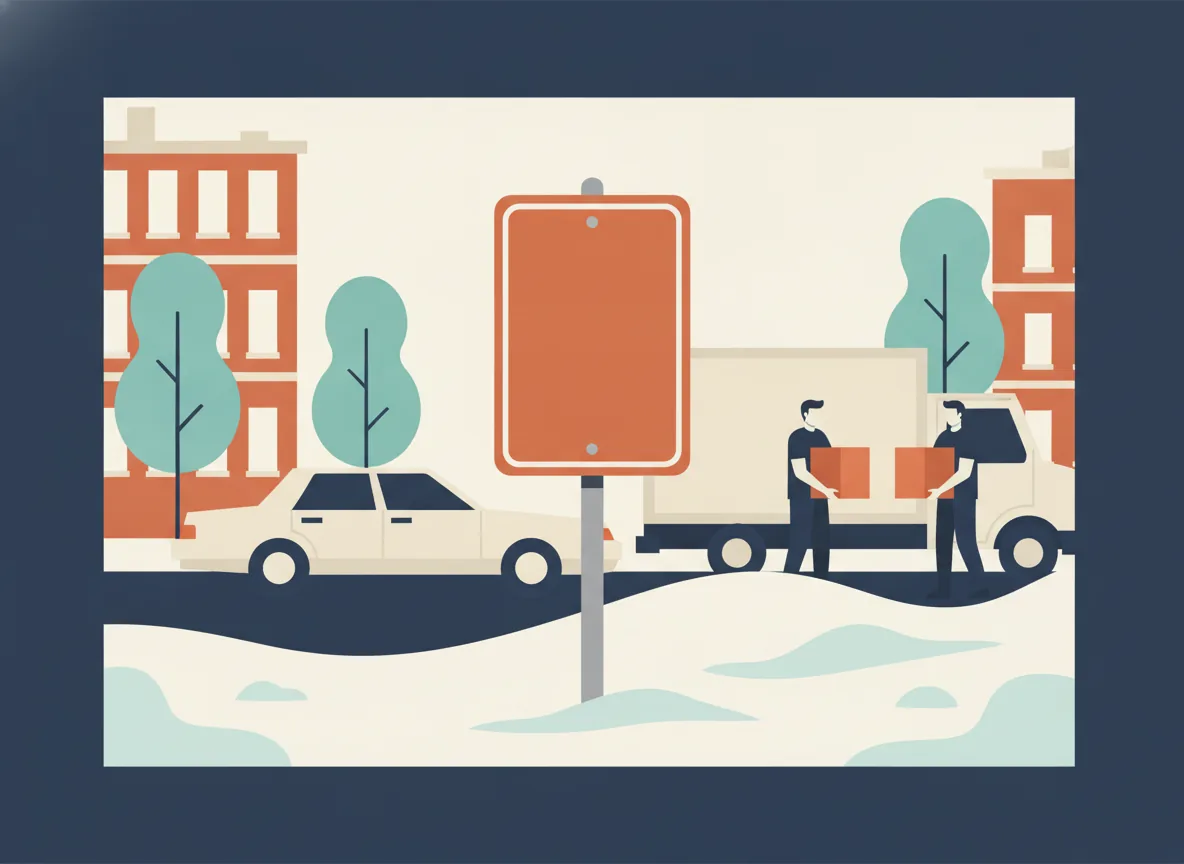
The orange sign overrides everything
Temporary signage beats permanent signs, resident vignettes and anything a moving permit said. Anjou posts 8 hours ahead; Saint-Laurent has towed on 4 hours' notice. Register your car and your street in the 311 Montréal app and it notifies you 60 minutes before the operation reaches you.
Official sources: snow-removal signage and posting times · live snow-operations map · 311 Montréal app · everything about snow removal in Montreal · 7 snow-removal myths (the 50,000 tows)
Winter parking for the truck
Is there a winter parking ban in Montreal? Depends which Montreal
In the 19 boroughs, no blanket night ban. Restrictions follow the plow: a street is only closed when an operation is running there, and the orange signs say when. The suburbs are the opposite, with fixed overnight bans that run all winter whether it snowed or not, and that is where a 7 a.m. truck gets surprised.

Montreal boroughs
Operation-based only. No snow operation on your street means the usual rules apply: borough truck time limits, the 5 m corner rule, meters. Our moving-truck permit guide covers all 19.Pointe-Claire
Street parking banned midnight to 7 a.m. from November 15 to April 15 unless the city lifts it that night. Check daily after 5 p.m. at 514 630-1205. Dumping snow in the street is prohibited at all times.Dollard-des-Ormeaux
Overnight parking banned 3 a.m. to 6 a.m. on city streets year-round, and banned entirely until further notice during an operation.Dorval
No parking 3 a.m. to 5 a.m. from November 15 to April 15, never more than 4 consecutive hours by day, and trucks only for immediate loading. Orange signs during operations.Laval, Terrebonne and the Montérégie
Laval switches sides during operations and runs lit signs in three sectors. Terrebonne bans midnight to 7 h unless authorized that night. Saint-Hyacinthe bans 1 h to 6 h. Each is on its own page: Laval, Terrebonne, Saint-Hyacinthe, Saint-Jean-sur-Richelieu.If the car is gone
Towed cars during loading are relocated nearby, not impounded. Info-remorquage finds them by plate; the Agence de mobilité durable answers at 514 868-3737. $99 to tow, storage free for 6 hours then $35 a day. If it is your own car on the curb the truck needs, move it the night before; a crew that arrives to find a car in the loading zone loses the first hour working from down the block.

Official sources: Pointe-Claire winter parking · Dollard-des-Ormeaux snow operations · Dorval parking rules · 2026 towing tariff (PDF)
Our side of it
What an AKA crew does differently between November and April
A winter move is the same furniture with three extra problems: the street, the walkway and the cold. The first one we solve the night before. The other two we solve with the truck's equipment and the order of loading.

The walkway: your part
Montreal requires owners to clear the building entrance and the parking access and forbids pushing snow onto the street or sidewalk. Salt the steps and the path to the curb before 8 a.m. Twenty metres of ice between the door and the truck is the slowest, most dangerous part of a winter move, and it is the only part the crew cannot fix on arrival.
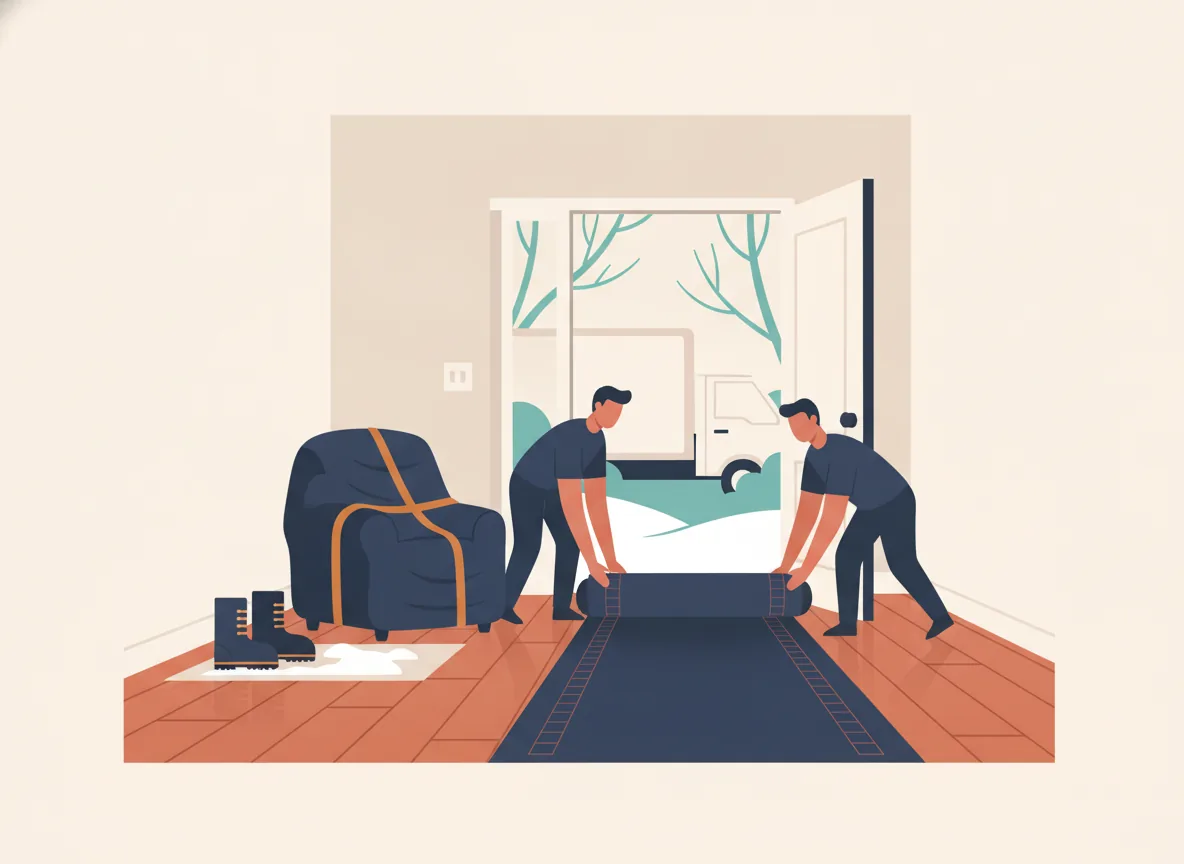
The floors: our runners
We lay floor runners and carpet protection from the door inward, because salt and slush on a hardwood floor is the damage people notice a week later. Mattress covers and blankets go on everything; wet snow is worse than cold.

The cold: load order and the box
Plants, electronics, liquids, candles, instruments and anything with a battery go in last and come out first, so they spend the least time in an unheated box. Electronics brought in from the cold sit an hour before being plugged in to avoid condensation.
The night before: the snow map
We check the City's operations map and the 311 app for both addresses. If a loading operation is scheduled on either street, we plan the truck position on the open side or a cross street, and we tell you where to leave your own car. This is the single thing that keeps a winter move on schedule.Tires and the truck
Quebec requires winter tires from December 1 to March 15 on passenger vehicles. Heavy vehicles are exempt by regulation, which is not the same as being safe: a loaded 26-footer on a Plateau side street in freezing rain is driven slower, parked flatter and loaded lighter, and on the worst mornings we move the start time rather than the truck.Daylight and hours
Sunset is before 4:30 p.m. in December. We start winter moves early and recommend a third mover on a full-house job so the unloading happens in daylight. The extra mover is often paid for by the hours saved.What we will not do
Run a generator or a fuel heater inside a garage or a closed space, even with the door open; Quebec public health is explicit about carbon monoxide. Carry propane, gasoline or anything flammable in the box. Both are the law and both are common sense.Official sources: clearing private property in Montreal · Quebec winter tire requirements · carbon monoxide prevention
The two homes
Heat, Hydro and the apartment you are leaving behind
The expensive winter mistake happens after the truck leaves: a vacated apartment with the heat turned off and a pipe that bursts on the 3rd, while the Hydro account is still in your name. Four things to settle before moving day.
Keep the heat on where you leave
If you pay the heating, Quebec rental law expects you to keep an adequate temperature to stop pipes from freezing, and the Tribunal administratif du logement's winter reference is about 21 °C. Leave it at a sensible setting until the end-of-service date, not at zero.Hydro-Québec, both addresses
Start service at the new address and end it at the old one in your Hydro-Québec customer space; doing it online is free, by phone it costs $25 plus tax. An account you forget to close stays yours and keeps billing.Read the meter
If either address has an old-style meter, note the reading as you leave and as you arrive, with a photo. Hydro's own moving checklist asks for exactly this.Address changes
One form at the Service québécois de changement d'adresse covers RAMQ, SAAQ, Revenu Québec and four others; the SAAQ gives you 30 days. Add Canada Post forwarding.
Official sources: Tribunal administratif du logement: heating · Éducaloi: heating and rental housing · Hydro-Québec moving checklist (PDF)

Price and timing
Winter is the easy season to book
Quebec leases end June 30, so the province moves in July and the industry's own advice is to avoid June 24 and July 1 if you can. A January or February weekday is the opposite: crews are available on a week's notice, the elevator in your building is not booked solid, and nobody is waiting behind you for the curb.
The rate
Winter is standard-rate season at AKA, from $125 an hour for two movers and $150 for three, with a 3-hour minimum plus transport and no winter surcharge. Rates climb and calendars sell out around June 21 and July 1; a winter weekday has none of that pressure, so the earliest call is the cheapest call either way.
What winter changes
The hours. A snowed-in walkway or a street closed for loading can add one, which is why the night-before check is part of every winter quote. Run your own numbers on the calculator, see what is included on the pricing guide, and if the new place is not ready until spring, our monitored warehouse holds everything in between.
AKA Moving
Questions
Winter moving in Montreal, answered
Q Can you move in winter in Montreal?
Yes, and it is the easiest season to book. Crews work at any temperature; what stops a move is a street closed by a snow-loading operation, which the City announces per sector with orange signs posted the same day before 3 p.m. for an evening ban or by 8 p.m. the day before for a daytime ban. We check the City's snow map and the 311 app for both addresses the night before and plan the truck position around it.
Q Is there a winter parking ban in Montreal?
Not a blanket one in the 19 boroughs: restrictions apply only during snow operations, announced by temporary orange signs that override all other signage. The suburbs are different: Pointe-Claire bans street parking midnight to 7 a.m. from November 15 to April 15 unless lifted, Dollard-des-Ormeaux bans 3 a.m. to 6 a.m. year-round, Dorval bans 3 a.m. to 5 a.m. in winter, Terrebonne midnight to 7 a.m., and Saint-Hyacinthe 1 a.m. to 6 a.m.
Q How much snow does Montreal get, and how cold does it get?
About 209 cm of snow a year on the 1981 to 2010 normals at Trudeau airport, with December and January near 50 cm each. January averages a high of -5 °C and a low of -14 °C, with about 8 days below -20. The record low is -37.8 °C on January 15, 1957. The City runs about five snow-loading operations a winter.
Q What happens if my car is towed during a snow operation?
It is usually relocated to a nearby street rather than impounded. Find it with the City's Info-remorquage tool by plate number or call the Agence de mobilité durable at 514 868-3737. Under the 2026 agglomeration tariff, towing for a snow operation costs $99 plus a ticket, and storage is free for the first 6 hours, then $35 per 24 hours for a car. About 50,000 vehicles are towed this way each winter.
Q Do I have to keep the heat on in the apartment I am leaving?
If heating is your responsibility under the lease, Quebec rental law expects you to maintain an adequate temperature so pipes do not freeze and burst, and the Tribunal administratif du logement's reference for a heated dwelling in winter is about 21 °C. Keep it at a sensible setting until your Hydro-Québec end-of-service date, and close that account online, which is free; by phone it costs $25 plus tax.
Q Does a moving truck need winter tires in Quebec?
Passenger vehicles registered in Quebec must have winter tires from December 1 to March 15, with fines of $200 to $300. Heavy vehicles are exempt by the regulation. AKA plans winter moves around the conditions instead: an earlier start, a lighter load, and on the worst mornings a later hour rather than a forced drive.
Q Is moving in winter cheaper in Montreal?
Winter is standard-rate season at AKA, from $125 an hour for two movers and $150 for three, with no winter surcharge; the rate pressure comes in late June and the first week of July, when calendars sell out. What winter saves you is availability and time: a weekday in January can be booked within a week, elevators and curbs are free, and there is no July 1 rush. What it can add is an hour for a snowed-in walkway or a closed street, which is why we check the snow map the night before.
Get your winter moving quote
Tell us both addresses and the date. We check the snow map the night before and plan the truck around it.